

The brands that break their categories (how they do it and how you can too)
Most brands try to be “better.” The ones that actually win decided to be something else entirely.

There’s a water company worth over a billion dollars.
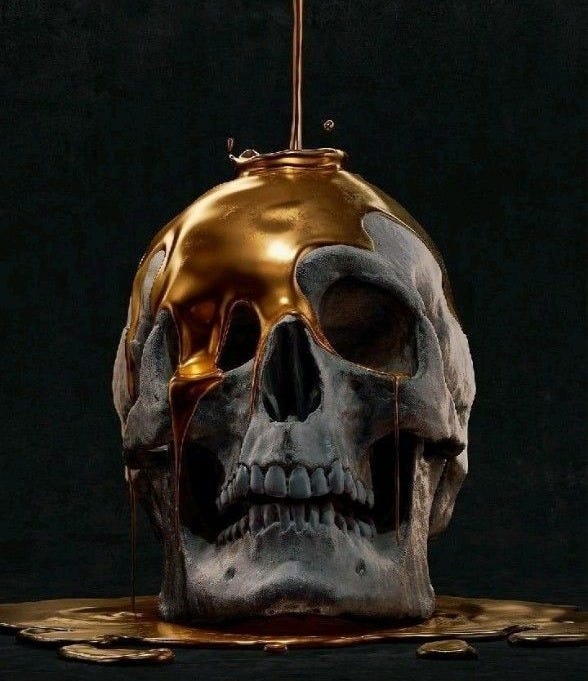
The water tastes like water. It comes in a can. The can has a skull on it. The tagline is “Murder Your Thirst.”
You probably know what company I’m talking about already.
Liquid Death has no proprietary formula, no patented filtration technology, no high-altitude glacier source story. It sells water. And yet it has reached a $1.4 billion valuation, expanded to over 113,000 retail locations, and built a merchandise operation that reportedly outsells the actual beverages.
This is the part where most marketing articles say something like “and that’s the power of branding!” as if that explains anything.
It doesn’t. So let’s actually talk about what’s happening here - and why the brands that break their categories operate on a completely different logic than the ones that play it safe.
The category lie
Every industry runs on assumptions that nobody questions.
Razors are expensive. (They’re not. They’re cheap to make. They’re expensive because they’re easy to steal and there’s almost no competition.)
Water brands should look clean, minimal, and pure. (Says who? The people already buying water, or the people who find the whole category painfully boring?)
Milk comes from cows. (Until a 40-year-old Swedish oat company decided to treat that assumption like a punchline.)
The brands that break through don’t start by asking “how do we do this better?” They start by asking “what does everyone in this category believe that isn’t actually true?”
Dollar Shave Club found the lie in razor pricing. Liquid Death found the lie in wellness aesthetics. Oatly found the lie in who gets to define “milk.” Tony’s Chocolonely found the lie in chocolate companies claiming to care about cocoa farmers while doing nothing structural about it.
That’s the starting point. Not differentiation. Not positioning. Identifying the lie.
Renovation is not disruption
Euromonitor International has a framework for this that’s worth understanding because it draws a clean line between three things that people constantly confuse.
Renovation is when you refresh what already exists. New packaging. Updated formulations. A new tagline. The goal is to stay top of mind and protect market share. It works. It’s also incremental.
Innovation is when you create a new subcategory or target a new audience segment within the existing market. This is where most “disruptive” branding actually lives - it’s meaningful change, but it’s still playing within the existing category structure.
Disruption is when entirely new categories or markets emerge. This is where things get interesting, and it requires a fundamentally different approach: reconceptualising the market, obsessive consumer centricity, community-driven engagement, and leadership that isn’t afraid to look stupid.
Most brands think they’re disrupting when they’re actually renovating. A rebrand is renovation. A new colour palette is renovation. Even a clever campaign is usually renovation. Disruption means the competitors have to rethink whether their entire approach still makes sense.
Four flavours of breaking the rules
Based on how this plays out in practice, disruptive brands tend to fall into four patterns.
The anti-brand rejects the visual and tonal conventions of its category entirely. It looks like it wandered in from a different industry. Liquid Death borrowed from heavy metal and craft beer. The pet care brand Mud built its entire identity around dirt - brown, grey, and black packaging - in a category obsessed with cleanliness and sterile whites. Anti-brands are high-risk because the rebellion has to feel real. If it reads as performative, it backfires fast.
The cult brand builds an identity so strong that the product becomes secondary to belonging. Harley-Davidson’s HOG community turned motorcycle ownership into a tribal affiliation. Patagonia made buying a jacket an act of environmental identity. The product matters, but the reason people stay is the community.
The disruptor brand enters an existing category with a business model that makes the dominant players’ approach look obsolete. Netflix didn’t make better DVDs. Airbnb didn’t build better hotels. Dollar Shave Club didn’t make better razors. They changed the underlying mechanics of how the product reached the customer, and the branding followed the model.
The challenger brand takes on category leaders through positioning and messaging without necessarily reinventing the business model. Oatly didn’t invent oat milk - the product had existed for decades. What changed was the voice: conversational, slightly sarcastic, self-aware, and treating every carton like a poster instead of a package. The creative team behind the brand said explicitly that they designed the packaging as their primary media channel.
These categories aren’t rigid. Liquid Death is both an anti-brand and a cult brand. Dollar Shave Club was both a disruptor and a challenger. But the distinction matters because each pattern carries different risks and requires different capabilities.
The six things that actually make it work
After looking at what the brands that break through have in common - and what separates the ones that stick from the ones that flame out - the pattern is consistent.
They make the brand the product. When the underlying product is a commodity, the brand itself is the competitive advantage. Cessario has said that the product has to be so interesting that the marketing is baked into it. Oatly’s creative team treats packaging as media. Tony’s Chocolonely designed packaging that communicates the mission without saying a word. In each case, the brand isn’t wrapped around the product - it IS the product.
They borrow visual codes from outside the category. Disruptive brands don’t iterate on the existing aesthetic of their industry. They import one from somewhere else. Liquid Death pulled from punk and heavy metal. Tony’s pulled from protest art. Mud pulled from the actual outdoors instead of the sanitised version pet brands usually present. This is what Polly Hopkins at FutureBrand was getting at when she wrote that disruptive brand building works by subverting consumer perceptions - not just through visuals or messaging, but by redefining what the category can even look like.
The risk here is convergence. When luxury fashion brands all adopted the same minimalist sans-serif logos in the mid-2010s (following Airbnb and Google’s lead), the disruption became the new conformity. Saint Laurent, Celine, and a dozen others ended up looking identical.
The lesson: borrowing from outside your category only works as long as you’re the only one doing it.
They build community before they chase scale. Harley-Davidson built HOG. Liquid Death built a loyalty program where you “sell your soul” to join. Nike turned product drops into community events through the SNKRS app. LEGO lets fans submit and vote on product ideas. The pattern is consistent: create spaces where your audience participates, contributes, and advocates. Then scale.
They anchor in a mission that’s structurally embedded, not bolted on. This is where a lot of brands get caught. WeWork talked about “changing the world” while running a conventional (and poorly managed) office subletting business. The narrative collapsed because there was no structural connection between the mission and the model. Contrast that with Tony’s Chocolonely, which open-sourced its entire supply chain through Tony’s Open Chain. The mission isn’t marketing - it’s infrastructure that competitors can join but can’t fake.
Liquid Death’s environmental positioning (aluminium over plastic) works for the same reason: it’s baked into the product format, not layered on top of it.
They treat controversy as content. Liquid Death turned its worst customer reviews into a death metal album called Greatest Hates. Oatly launched a website leaning directly into criticism. Both brands understood something that most companies don’t: backlash, handled well, strengthens loyalty among the people who already care.
This requires preparation. You need a response strategy before the controversy hits, not after. Brands that survive backlash are the ones who expected it.
They test the brand before the product. Cessario spent $2,500 on a Facebook page for Liquid Death before the product existed. The page built 60,000 followers and became his proof of concept for the first funding round. This inverts the normal sequence. Instead of building a product and then figuring out the brand, you validate that the positioning resonates and then build the product around it.
Where this goes wrong
Disruptive branding has a body count.
WeWork is the most visible casualty - a disruptive brand aesthetic applied to a conventional (and flawed) business model. The gap between what the brand promised and what the company delivered created more damage than no disruption at all.
But there are subtler failures too.
When disruption is costume rather than conviction, audiences can tell. A brand that looks rebellious but operates like every other company in the category has a shelf life measured in months. The aesthetic without the substance is just another flavour of inauthenticity.
When everyone in a category adopts the same “disruptive” approach, nobody stands out. The luxury fashion minimalism wave proved this. At a certain point, the disruption became the category norm, and distinctiveness vanished.
And when companies scale faster than their brand can support, the customer experience can’t keep up with the promise. WeWork expanded globally at a pace that made consistent delivery impossible. Speed without substance is fatal.
The questions worth asking
Whether you’re starting something new or rethinking something that already exists, the diagnostic is the same.
What is the biggest unquestioned assumption in your category? What do customers accept because they believe there’s no alternative?
Who is being underserved, overcharged, or excluded by the current market? Where are people using workarounds?
What would your brand look like if it borrowed its visual identity from an entirely different industry?
What does your brand stand against? Not which competitor. Which norm?
Can you test the positioning before building the product?
Is your mission embedded in the business model, or does it only exist in your marketing?
What’s your plan for when people push back?
The real point
The brands that break their categories didn’t get there by being a slightly better version of what already existed. They got there by refusing to play the same game.
That’s not a creative exercise. It’s a strategic one. It requires identifying what’s broken about the category, building an identity around fixing it, and having the operational substance to back it up when people start paying attention.
The good news: you don’t need a new product to do it.
Liquid Death proved that the most boring commodity on earth - water - can become a billion-dollar brand when the brand itself is the innovation.
The hard part isn’t the branding. It’s the conviction to actually do something different when everyone around you is playing it safe.

Hi, I’m Jessica.
So glad you’re here reading my stuff. Thank you for that!
I help quiet founders build (personal) brands that stand out without the constant visibility grind. Disruptive branding, sharp positioning, and strategy that works even if you hate being on camera. Most strategists talk about alignment. I talk about opposition.
New essays hit your inbox weekly. Subscribe if you want in. Unsubscribe whenever. No guilt trips. Just good strategy and the occasional swear word.
thank you so much for this essay, Jess!!! it was awesome! I really like the "questions worth asking" section!